An electron-density point-cloud framework for robust protein-ligand interaction prediction
* Equal contribution. † Corresponding author.
Structure-based affinity models are sensitive to atomic coordinate noise, which is common in low-resolution crystal structures and even more severe in AlphaFold-predicted proteins. Atom-level networks that assume sub-angstrom accuracy therefore degrade on non-covalent interactions. E-CloudBind represents the complex as electron-density point clouds fused with molecular graphs, so interaction learning does not depend on exact atomic coordinates.
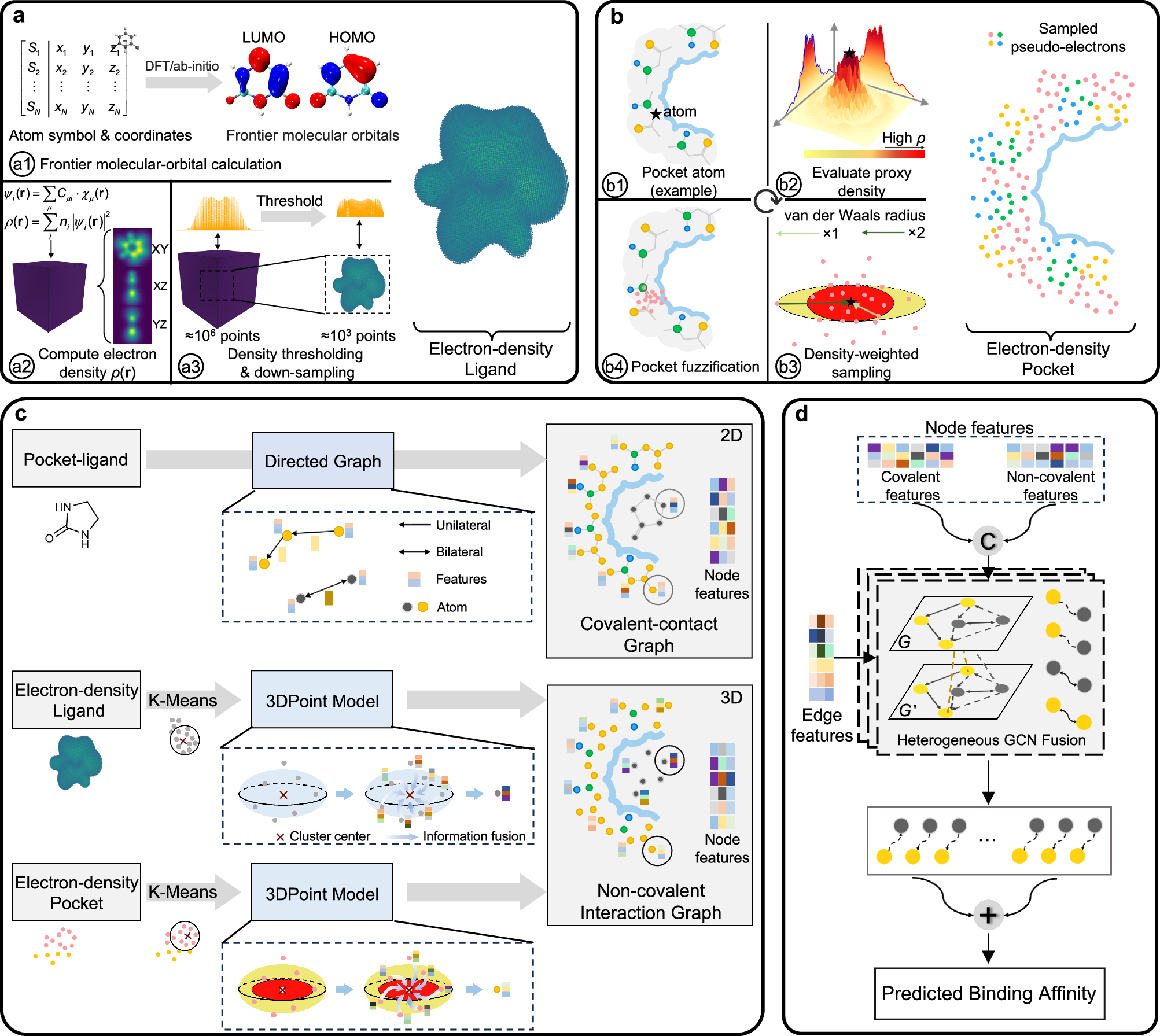
As shown in Fig. 2, ligand electron densities are computed with semi-empirical quantum calculations, while protein pockets are represented as van der Waals-guided Gaussian point clouds. When electron-density isosurfaces intersect, a resolution-agnostic interaction graph is constructed. A point-cloud encoder captures local non-covalent patterns and is fused with covalent molecular-graph features; a heterogeneous graph network then regresses binding affinity and remains robust across structural quality levels.